
In the first part of our Beyond Price series, we talked about the Value Gap: the distance between what your firm does behind the scenes and what a family actually understands. If you missed that article, the short version is this: most families aren’t price shoppers. They’re information seekers who don’t have the vocabulary to ask for what they really want.
But here’s the question that kept coming up after we published it: “Okay, so I close the Value Gap. I educate the family. Then what? What keeps them from taking that education and using it to price-shop somewhere else?”
Fair question. And the answer is the thing that separates the firms that are always competing on price from the firms that rarely have to: trust.
Education gets a family to understand your value. Trust is what gets them to choose you over the place down the road that offers the same services for less. Education is the map. Trust is the reason they want you to guide them through it.
Why education alone isn’t enough
In Part 1, we talked about becoming an Expert Guide instead of an order taker. That’s still true. But education has a ceiling. You can explain the difference between direct cremation and a full service with a viewing. You can walk a family through why your identification process gives them peace of mind. You can translate every line item on your GPL into a benefit they actually care about.
And a family can listen to all of that, thank you, hang up, and call the next firm on their list.
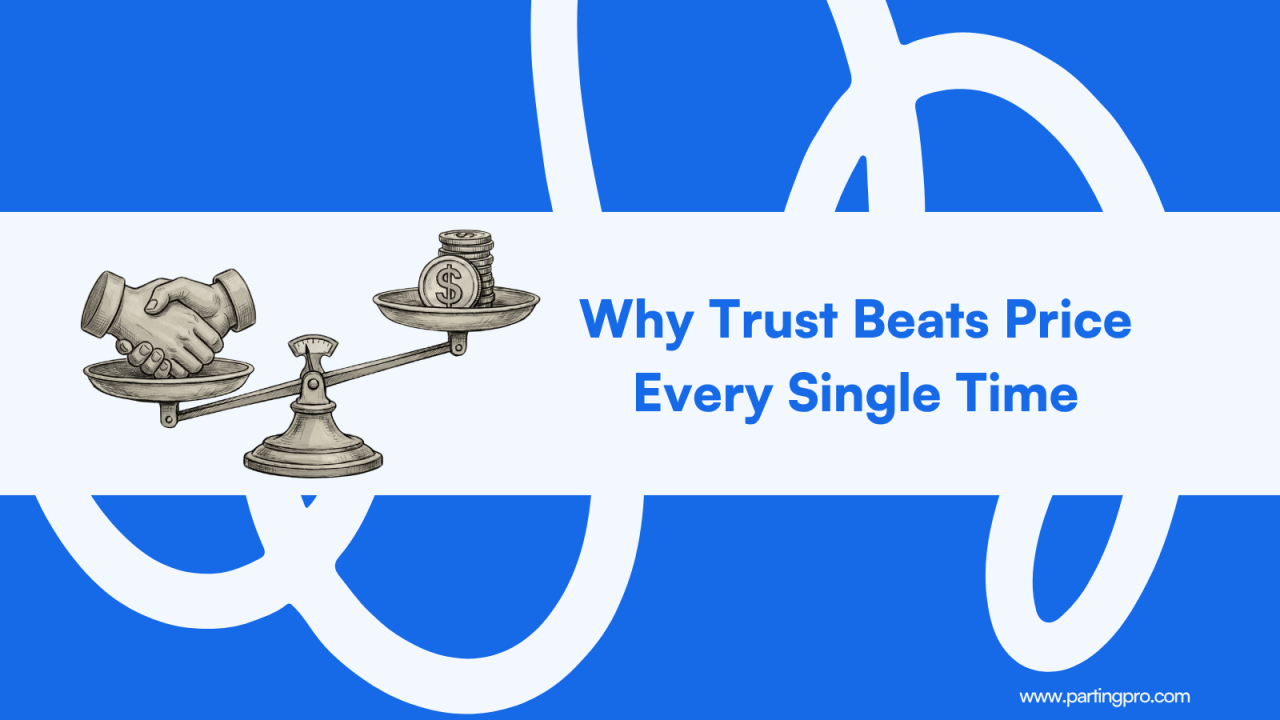
Education tells a family what you do. Trust tells them who you are. And when a family is making a decision at the worst moment of their lives, who you are matters more than what you offer.
A Harvard Business School study on trust in service industries backs this up: customers who rated a provider as “highly trustworthy” were 38% less likely to negotiate on price and 52% more likely to say yes to additional services. In your arrangement room, that’s the difference between a family choosing the minimum package and a family saying yes to the tribute video, the upgraded urn, or the catered reception. Not because you upsold them, but because they trusted your guidance.
What trust actually looks like inside a funeral home
Trust isn’t a mission statement on your wall. It’s not a tagline (like “serving families since 1958”). It’s built in specific, concrete moments that families experience before, during, and after the arrangement. Here’s where we see it happening at the firms that do this well.
Before the first meeting: transparency
The families who walk into your arrangement room most relaxed are the ones who already know what to expect. They’ve seen your pricing online. They’ve browsed your service options. They’ve read a “what happens when you call us” page on your website that walked them through the process in plain language.
The families who walk in most guarded are often the ones who feel like they’re about to get sold something. They couldn’t find pricing anywhere. The website was all stock photos and vague promises. They show up bracing for a number they can’t predict, and that anxiety turns into resistance.
One director we work with put it this way: “When I started posting our packages and pricing on the website, I thought it would scare people off. Instead, the families who called were calmer. The arrangement meetings got shorter. And the average spend actually went up, because families weren’t starting from a defensive crouch.”
During the arrangement: turning details into trust
In Part 1 of this series, we talked about acknowledging first and educating second. That’s step one. But trust goes further than acknowledgment. Trust happens when a family realizes you’re not just listening to be polite; you’re listening because it changes what you recommend.
Here’s what that looks like in practice. A family mentions that Dad was a Marine. Instead of moving on to package options, you make a note. Later in the arrangement, you suggest a flag-folding ceremony and offer to coordinate with the local VFW post. The family didn’t ask for that. They didn’t know it was an option. But because you listened, you could offer something that felt personal instead of transactional.
That’s the difference between education and trust. Education says, “Here’s what we offer.” Trust says, “Here’s what I think would be right for your family, based on what you’ve told me.” One is a menu. The other is a recommendation from someone who’s been paying attention.
When the recommendation fits, families stop comparing. They’re no longer evaluating your services against a competitor’s. They’re following the guidance of someone who gets it.
Between families: letting others do the talking
When someone’s choosing a restaurant, they check Yelp. When they’re choosing a contractor, they ask a neighbor. When they’re choosing a funeral home during the worst week of their lives, they’re looking for the same thing: evidence that someone like them was taken care of here.
Google reviews matter. A short testimonial on your homepage matters. A handwritten thank-you card from a family, pinned to the corkboard in your lobby, matters. These aren’t marketing tactics. They’re trust signals. In a high-emotion, high-stakes decision where families feel completely out of their depth, those signals carry more weight than anything you could put in a brochure.
The firms we work with that actively ask for Google reviews (via a simple follow-up email two weeks after the service) see a measurable difference in both call volume and price sensitivity. Families who arrive having read reviews walk in with trust already partially built. That’s less work for you and a better experience for them.
After the service: the details that compound
Dad was a Cubs fan. Mom always had fresh flowers on the kitchen table. The grandkids called him Pop-Pop. He made the best chili in the county and everyone knew it.
When you remember those details—when you weave them into the service, when you reference them in a follow-up email a week later, or when you bring them up if the family calls a year later about a headstone—you stop being a service provider. You become their funeral director. Not the funeral home, but their person.
That distinction is everything. A family doesn’t price-compare someone who already feels like their person. They don’t Google alternatives. They tell their neighbors, their church group, and their coworkers: “Call Ashley. She took care of everything. She remembered that Dad loved the Cubs and she found a way to work it into the service.”
That’s a referral you could never buy with a discount.
The math of trust vs. the math of discounting
Let’s run the numbers, because this is where it gets real.
Say your average arrangement is $2,500. You discount 10% to win a price-sensitive family. That’s $250 off the top. Do that ten times a month and you’re leaving $2,500 on the table, which is $30,000 a year. And those families? They came to you for the price. When a competitor undercuts you next year, they’re gone.
Now say you invest that same energy into trust-building. You train your front desk to listen for 60 seconds before talking services. You add reviews and a “what to expect” page to your website. You send a follow-up email a week after every service. Your average arrangement stays at $2,500 or goes up slightly because families are saying yes to personalized options they actually want.
More importantly, those families tell people about you. Funeral industry data consistently shows that word-of-mouth is the number one driver of funeral home selection. One family who trusts you becomes two families next year. Trust compounds. Discounts don’t.
The bottom line: You can’t discount your way to a referral network. But you can earn one by making every family feel like the only family you’re serving that week.
Five things you can do this week
Trust doesn’t require a renovation or a rebrand. Most of it is small, repeatable behavior. Here are five things you could start doing this week:
- Answer the phone with a question, not a script. After you get the caller’s name, ask one thing about the person who passed. “Tell me a little about your mom.” That’s it. You’ll be surprised how much it changes the rest of the call.
- Put your GPL on your website. Yes, really. The FTC requires you to provide it on request anyway. Posting it proactively signals that you have nothing to hide. Families who can see prices beforehand spend less time anxious and more time planning a meaningful service.
- Ask for one Google review this week. Pick a family you served recently who you know had a good experience. Send a short, personal email: “It meant a lot to our team to help with your father’s service. If you have a moment, a Google review helps other families find us.” Keep it human and keep it short.
- Add team photos and short bios to your website. Families calling during the worst week of their lives want to know a real person is going to answer. Knowing Sarah coaches her daughter’s soccer team and has been with your firm for eight years does more for trust than any list of certifications.
- Send a follow-up email 14 days after every service. Keep it short. Reference something specific about the family or the loved one. Something like: “We’ve been thinking about your family this week. Your dad’s service was one we won’t forget.” Two sentences, personal, and no sales pitch. That’s the kind of email people don’t delete.
The real competition
The firm across town can match your prices. They can copy your service packages. They can build a nicer building. What they can’t copy is the way a family felt when your director remembered that their mother loved gardenias and made sure the arrangement room smelled like them.
Price is a number. Trust is a feeling. And feelings are what families remember when someone asks them, six months later, “Do you know a good funeral home?”
Lead with trust. The rest follows.